
● Teleport operational 24 / 7
SGS operates satellite ground infrastructure in Rantau, Negeri Sembilan — gateway hosting, uplink, capacity leasing, backhaul and colocation, delivered from a single integrated site licensed by the MCMC.
Satcom Gateway Services Sdn Bhd holds the relevant licences and registrations issued by the Malaysian Communications and Multimedia Commission (MCMC).
Authorises SGS to own or provide network facilities.
Authorises SGS to provide network services.
Registered for the provision of applications services.
From hosting an operator’s gateway on our antenna farm to leasing capacity and racking equipment in our data hall — SGS covers the full path from space to fibre.
Antenna positions, RF chain, equipment space and site operations to bring an operator’s gateway into service.
Managed GEO capacity across APStar-5C, APStar-6D and APStar-9, plus low-latency LEO via SPACESAIL.
Enterprise VSAT networks and backhaul for sites where terrestrial infrastructure is limited or unavailable.
Maritime and aeronautical connectivity supported by Ku-band mobility beams and hybrid GEO–LEO routing.
Carrier-neutral Tier III-class rack space, redundant power and interconnection, metres from the antenna farm.
Installation, commissioning, maintenance and remote support delivered by the team that runs the station.
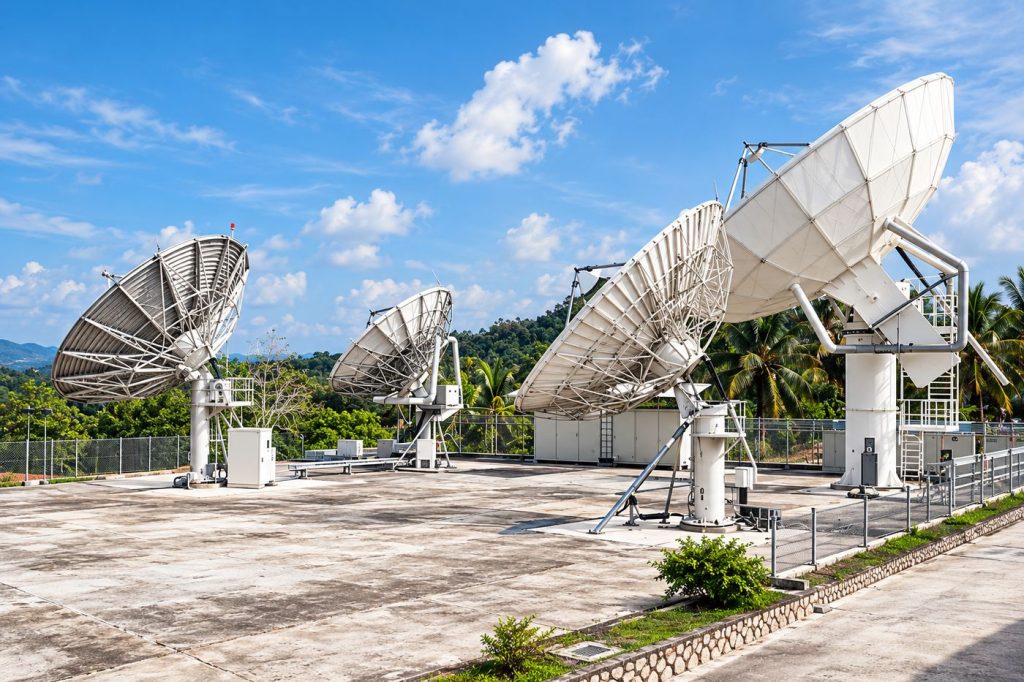
Our Kuala Lumpur gateway (KL2) sits 68 km from KLIA and 80 km from the metropolitan core — far enough for a clean RF environment, close enough for engineering access. It is linked to the TSGI ground station (KL1) by 65 km of dark fibre operating in full redundancy.
SGS provides gateway hosting and capacity across the APStar geostationary fleet and the SPACESAIL low-earth-orbit constellation — so a single commercial relationship can cover both.
FS-1300 platform, 34 C-band and 32 Ku-band transponders, regional Ku-HTS payload, 15+ year design life.
Five-beam Ku-band user payload with a Ka-band gateway over Kuala Lumpur, optimised for aero and maritime mobility.
Broad regional coverage supporting video distribution, data and telecom services across the Asia-Pacific.
Low-latency LEO capacity building toward a 648-satellite constellation, hosted through the SGS LEO gateway.
SGS hosts gateway operations for the APStar geostationary fleet and the SPACESAIL low-earth-orbit constellation on the same site — so a hybrid network needs one teleport, one engineering team and one agreement.
Antenna positions, RF chain, secure equipment space, redundant power — and the engineers who keep it all running. Carrier-neutral, MCMC-licensed, and 68 km from Kuala Lumpur International Airport.
They need dependable ground infrastructure, operational expertise and a partner able to respond to the technical demands of mission-critical communications.
No preferred upstream. Operators, carriers and enterprises interconnect on equal terms with multiple fibre providers on site.
Hybrid architectures combining geostationary reach with LEO latency, including hybrid router solutions for resilient links.
A strategic alliance partner under APT Satellite Holdings, giving direct access to established regional fleet capacity.
MCMC individual licences as NFP and NSP, plus ASP(C) registration — a regulated counterparty for long-term hosting.
Installation, integration, commissioning, maintenance and remote support delivered by the team that runs the station.
Capacity and floor space to scale with cloud, OTT and IoT traffic, plus lower-CAPEX options using refurbished VSAT hardware.
Offshore platforms, pipelines and remote field operations.
VSAT connectivity for vessels, fleets and port operations.
Plantation telemetry, sensors and rural connectivity.
Resilient and emergency communications for public agencies.
A hybrid router solution integrating GEO and LEO networks for resilient, low-latency links that hold up when one network degrades.
Ultra-low-cost LEO connectivity for connected devices, sensors and remote monitoring — and for emergency use where terrestrial networks are unavailable.
Cost-effective bandwidth packages tailored to enterprise, oil & gas, maritime and rural deployments, with lower-CAPEX equipment options.
Announcements, technical updates and event news from the Rantau ground station will appear here as they are published.
Tell us about your coverage, capacity and hosting requirements — our engineering team will come back with a site and service proposal.